Quick answer
There is no single best prediction market tool, because the category is six different jobs. We track all 288 of them. Data and APIs: PMXT, Oddpool, Probalytics. Whale tracking: Polymarket Analytics, Prediedge. Research: Polysights, Predictions Terminal. Arbitrage: ArbBets, Eventarb. Bots: Prediction Market Toolkits, Homerun. Execution: Kairos, Kalshi Pro, Stand. Two numbers sort the whole field: 191 of the 288 read exactly one venue, and 138 cannot place an order at all.
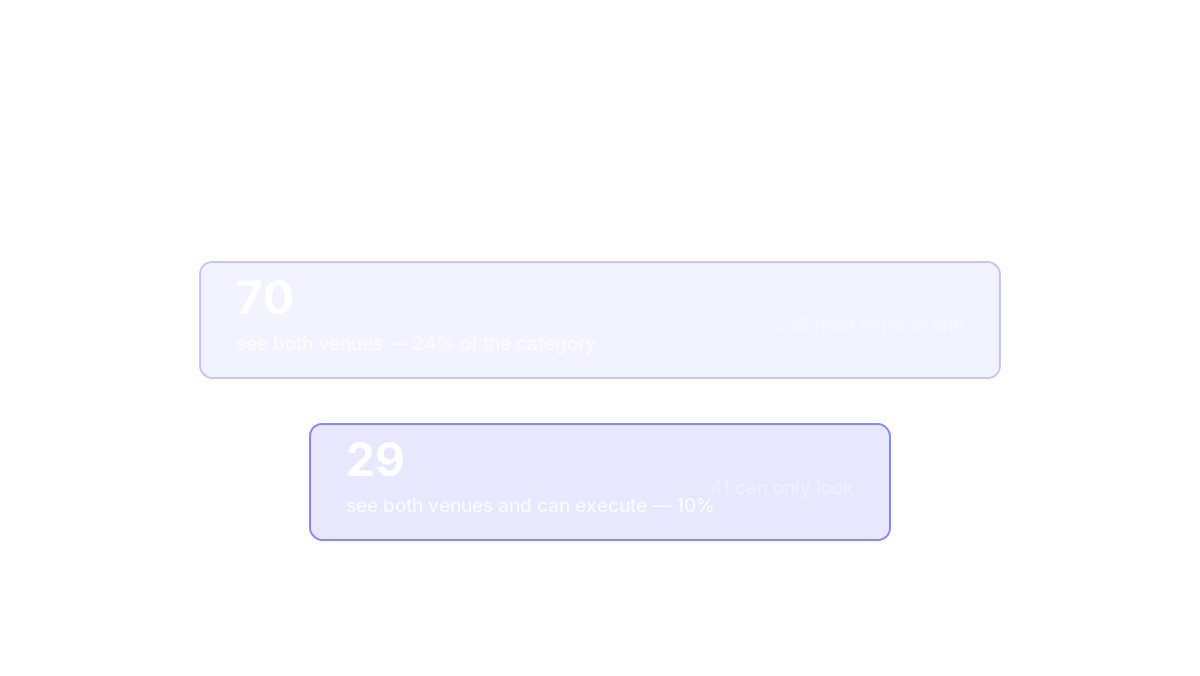
Twenty-nine tools clear both bars. This is one.
Kairos merges Kalshi, Polymarket and Predict.fun into one book. Global best bid and best ask, sub-second data, advanced order types, low-latency execution. A 0.01% platform fee, and venue fees at cost.
Prediction markets are the derivatives layer on top of the entire world. Two hundred and eighty-eight tools now compete to sell you a better view of it.
We know, because we counted them. Every tool below comes out of a census we maintain in public: name, venues covered, whether it can execute, what it charges, its licence, whether the site still resolves, and the date we last checked. The whole dataset is on GitHub, link-checked weekly.
Every other ranking of these tools scores polish and popularity. Those are the things directories get paid on. Three facts actually decide whether a tool earns its place in your workflow.
How many venues it can see. Whether it can place the order. What it costs.
Sort 288 tools on those three and the field collapses fast.
| Measure | Tools | Share of 288 |
|---|---|---|
| Tracked in the census | 288 | — |
| Read exactly one venue | 191 | 66% |
| See both Kalshi and Polymarket | 70 | 24% |
| See both venues and can execute | 29 | 10% |
| Cannot place an order at all | 138 | 48% |
| Touch Polymarket | 240 | 83% |
| Touch Kalshi | 82 | 28% |
| Free, with no paid tier at all | 148 | 51% |
| Publish no price anywhere | 81 | 28% |
| Name a monthly or weekly price | 16 | 6% |
| Open source | 109 | 38% |
| Dead or unreachable at last check | 21 | 7% |
Read the third row again. Two hundred and forty tools are built on Polymarket. Eighty-two touch Kalshi — the venue trading more volume. The tooling ecosystem grew up on the venue with the public blockchain, not the venue with the flow.

That is the structural gap in this category, and it is why the sections below are organised by job rather than by rank. Nothing here wins outright. Each tool wins one job, and most of them win it on one venue.
What kinds of prediction market tools are there?
Thirteen categories, and they are not evenly filled. The census sorts every tool by what it is for, and the shape of that sort is the second finding on this page.
| Category | Tools | What it does |
|---|---|---|
| Data & APIs | 58 | Order books, trades, historical prices, normalized symbology |
| AI Agents & Research | 49 | Screens, agents, summaries, transcript and model search |
| Analytics & Whale Tracking | 42 | Wallet scoring, large-fill feeds, leaderboards |
| Terminals & Aggregators | 30 | Trading surfaces, one or several venues |
| Trading Bots & Chat Trading | 25 | Automated strategies, Telegram and Discord execution |
| Infrastructure & DeFi | 23 | Wallets, bridges, custody, on-chain plumbing |
| Directories & Other | 12 | Lists of the other 276 |
| Dashboards | 12 | Read-only volume, open interest and user charts |
| Alerts | 11 | Push and chat notifications on market events |
| News & Education | 8 | Coverage, explainers, newsletters |
| Arbitrage | 7 | Cross-venue price-gap detection and execution |
| Copy Trading & Portfolio | 6 | Follow a wallet, track a book |
| Parlays & Leverage | 5 | Combined and levered positions |
Job 1 of 6 · 58 tools tracked
Market data and APIs
What is the best prediction market API?
The largest category in the census, and the one that separates fastest. Fifty-eight tools sell you the raw material: order books, trades, historical prices, normalized symbology across venues.
The split that matters is normalized versus native. A native API gives you one venue exactly as that venue models it. A normalized API gives you several venues in one shape, and charges you for the mapping work you would otherwise do yourself. Both are correct answers to different problems.

PMXT
15 venues · Executes: Yes · Free (MIT)
CCXT, rebuilt for prediction markets. One Python and TypeScript interface for market data and order placement across Polymarket, Polymarket US, Kalshi, Limitless, Metaculus, Smarkets, Hyperliquid and more, hosted or self-signed. The widest venue coverage of anything in the census, at any price.

Oddpool
Kalshi, Polymarket + · Executes: No · Free 1,000 req/mo; Pro $30/mo; Premium $100/mo
Normalized real-time and historical data aimed at market makers and funds. Priced like infrastructure rather than a subscription, and one of the few here that publishes a rate card at all. It does not route orders.

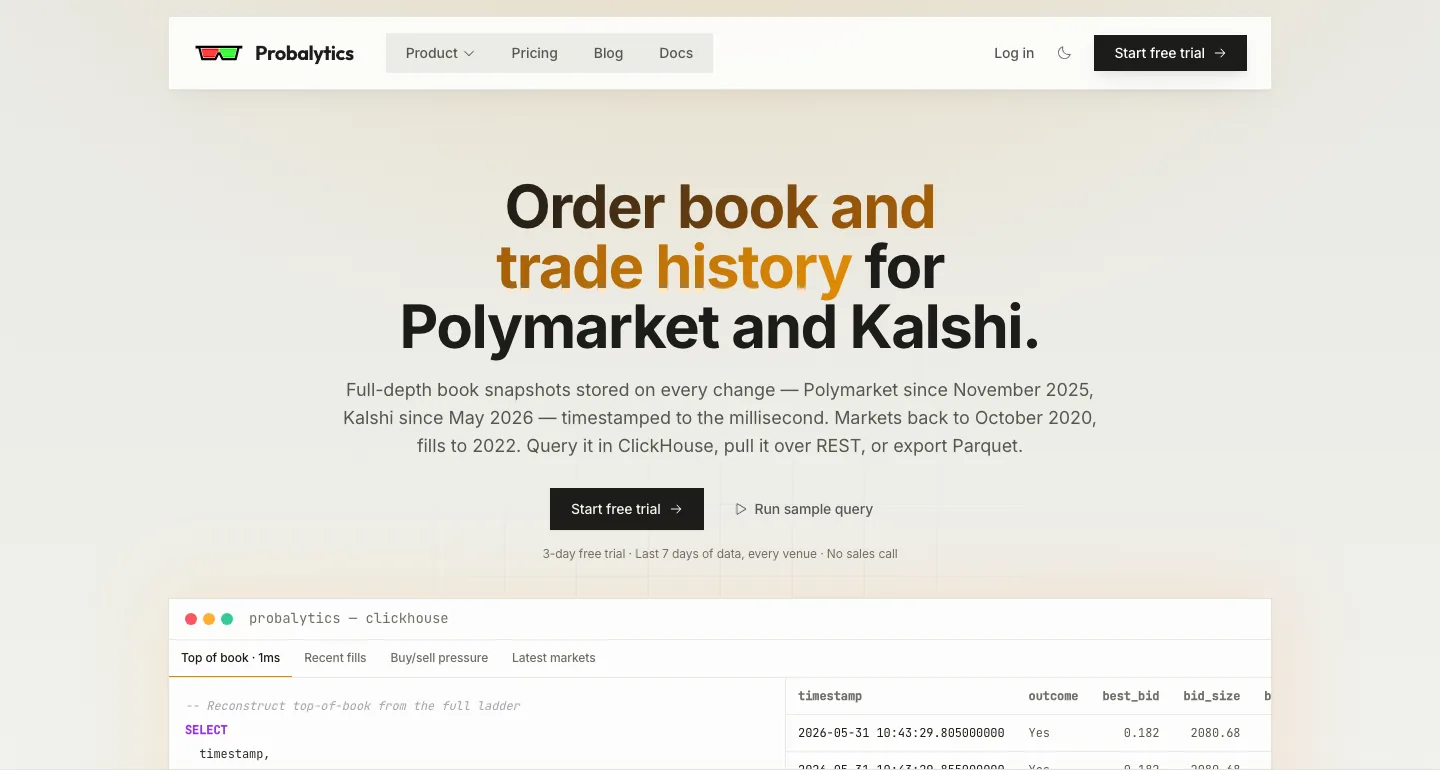
Probalytics
Polymarket, Kalshi · Executes: No · $39 to $249/mo
Historical trades and 1ms order-book snapshots over REST, ClickHouse SQL, a Python SDK and Parquet exports. The serious backtesting dataset in the category. If you are fitting a strategy rather than watching a screen, start here.

PolyRouter
7 venues · Executes: No · Free (open beta)
One key for normalized odds and price history across seven prediction market and betting venues, with an MCP server for agents. Free while it is in beta, which makes it the cheapest way to prototype a cross-venue idea.

Adjacent News
Index provider · Executes: No · Free public API
Indices and reference rates rather than raw books, served over a public JSON API with no auth on a 15-minute delay, plus an MCP server and an llms.txt. Backed by a $2.5M pre-seed from VanEck, Night Capital and DCG to build the index layer for event contracts.

Kalshi Trading API
Kalshi · Executes: Yes · Free
REST, WebSocket and FIX, RSA-PSS signed, with a demo environment and rate-limit tiers that rise with your volume. FIX support is rare in this category and tells you who Kalshi expects to show up.

Polymarket Gamma and CLOB
Polymarket · Executes: CLOB only · Free
Gamma reads events and markets with no authentication at all, which is precisely why 240 of the 288 tools in this census are built on Polymarket. CLOB handles signed order placement and cancellation.

Kairos API
Kalshi, Polymarket, Predict.fun · Executes: Yes · 0.01% platform fee, venue fees at cost
One REST and WebSocket API across every venue we ingest, covering execution, market data and trader intelligence. Non-custodial if you want it: request an order intent, sign it with your own key, submit.
The catch with going native is that you do not integrate one API, you integrate several, each with its own auth, rate limits, symbology and websocket semantics, and none of them shows your positions on the others. That work is identical for everyone who does it. Do it once, or let something else do it.
Job 2 of 6 · 42 tools tracked
Whale and wallet tracking
What is the best Polymarket whale tracker?
Forty-two tools watch the money. This is the most crowded and least differentiated job in the category, because Polymarket settles on a public blockchain and every trade has always been visible. Watching it was the only inconvenient part, and forty-two teams have now solved that same inconvenience.
So judge these on the second-order question, not the first. Anyone can list big trades. Scoring the wallet behind the trade, and covering more than one venue, is where the field thins out.

Polymarket Analytics
Polymarket · Executes: Yes · Free; Falcon API paid
The largest third-party index of Polymarket: every trader, market, position and trade, with leaderboards, portfolio views and in-app trading. The free tier is genuinely deep, and the paid Falcon API is the escape hatch when you want to script against it.

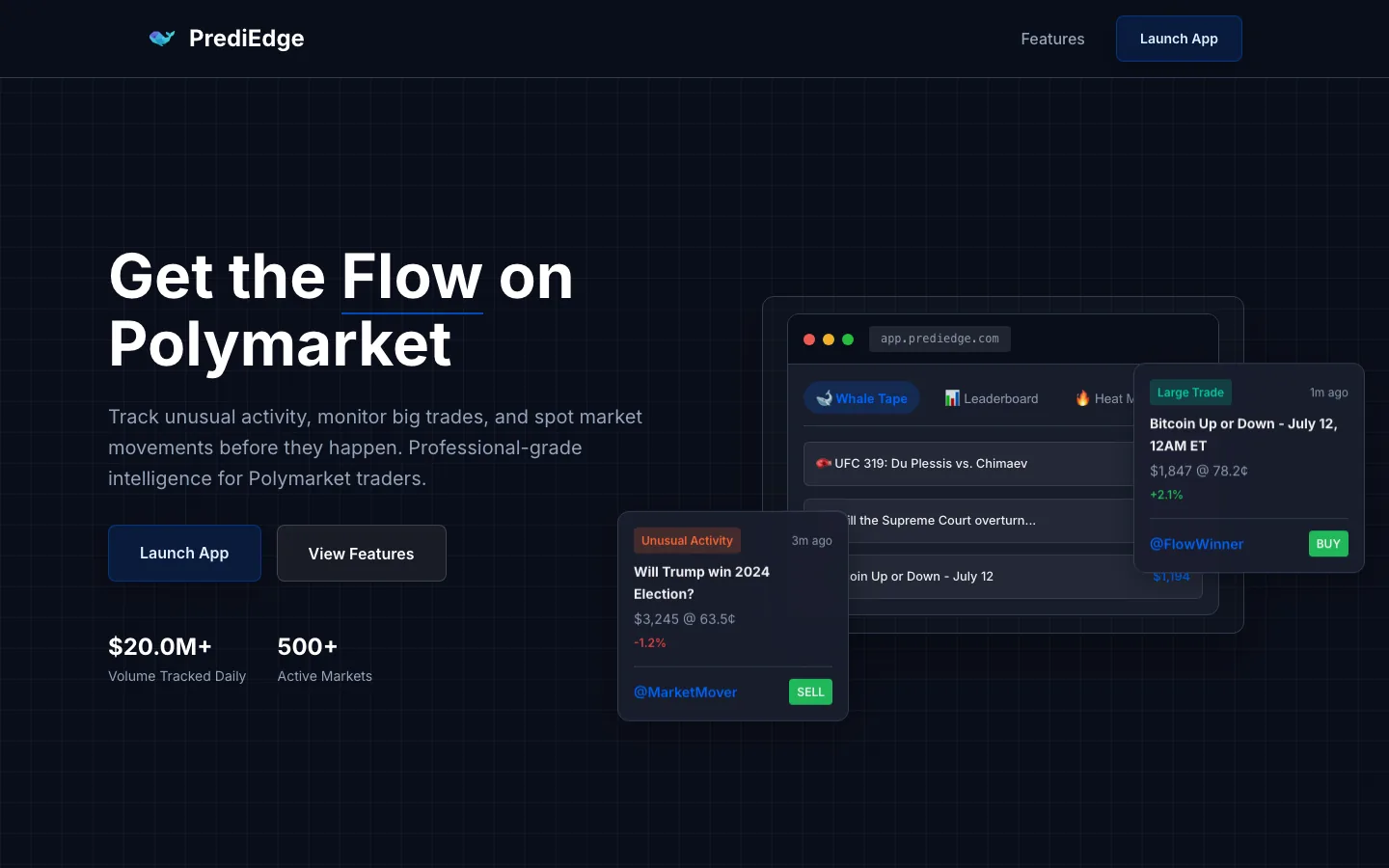
Prediedge
Polymarket, Kalshi · Executes: No · Not published
One of the few whale feeds that covers both venues, flagging trades over $1,000 and suspected insider activity. Cross-venue coverage is the differentiator; the missing pricing page is the tradeoff.
Kairos whale tracker
Polymarket · Executes: No · Free, no signup
Ours, and free with no login: every Polymarket fill over $10,000 as it happens, plus an anonymous-wallet watch for unnamed money moving with size. The prediction market leaderboard ranks the wallets behind it by realized profit.
polyterm
Polymarket, Kalshi · Executes: No · Free, open source
A Python terminal app: whale tracking, order-book views, arbitrage checks against Kalshi, and an MCP server. View-only by design, and it says so — which is more honest than most of this list.

PolyTrack
Polymarket · Executes: No · $9.99/week
A signal desk rather than a feed: big trades, volume spikes, fresh wallets and clustered activity, each with a severity score and Telegram alerts. Priced weekly, which is unusual, and worth noticing before you subscribe.

PolyInsider
Polymarket · Executes: No · Free
A free live tape of Polymarket bets over $5,000 plus first-time wallets and news matched to markets. The cheapest way to develop a feel for what the flow looks like before paying anyone for it.
Polymarket-only readers should start with the Polymarket analytics roundup, which compares the dashboards head to head. One honest note on the whole category. Every tool here sells a variant of "insider detection", and none of them can prove insider knowledge. What they detect is an unnamed wallet, freshly funded, taking a confident position. That is a signal. It is not evidence, and any tool that tells you otherwise is selling.
Job 3 of 6 · 49 tools tracked
Research screens and analytics
What do prediction market traders use for research?
Forty-nine tools help you find the trade. Screeners, market comparisons, transcript search, weather models, AI summaries of what moved a market overnight.
The research screens are the most useful tools in this census and the most dangerous to build a workflow on, for one reason: almost none of them can act. A screen finds the trade, then hands you back to a browser tab.

Polysights
Polymarket, Kalshi · Executes: Yes · Free
The most complete research screen in the category, and it closed its own biggest gap this year: as of our last check it covers Kalshi alongside Polymarket and executes. Market screener, insider finder, wallet analysis, workflows, and API and MCP access. Our longer take: the Polysights review.

Predictions Terminal
Polymarket, Kalshi, sportsbooks · Executes: No · Free + Pro $49/mo
30,000+ markets with an arbitrage scanner, whale tracker, news scoring, paper trading and a strategy backtesting lab. The broadest feature surface of anything that does not execute.

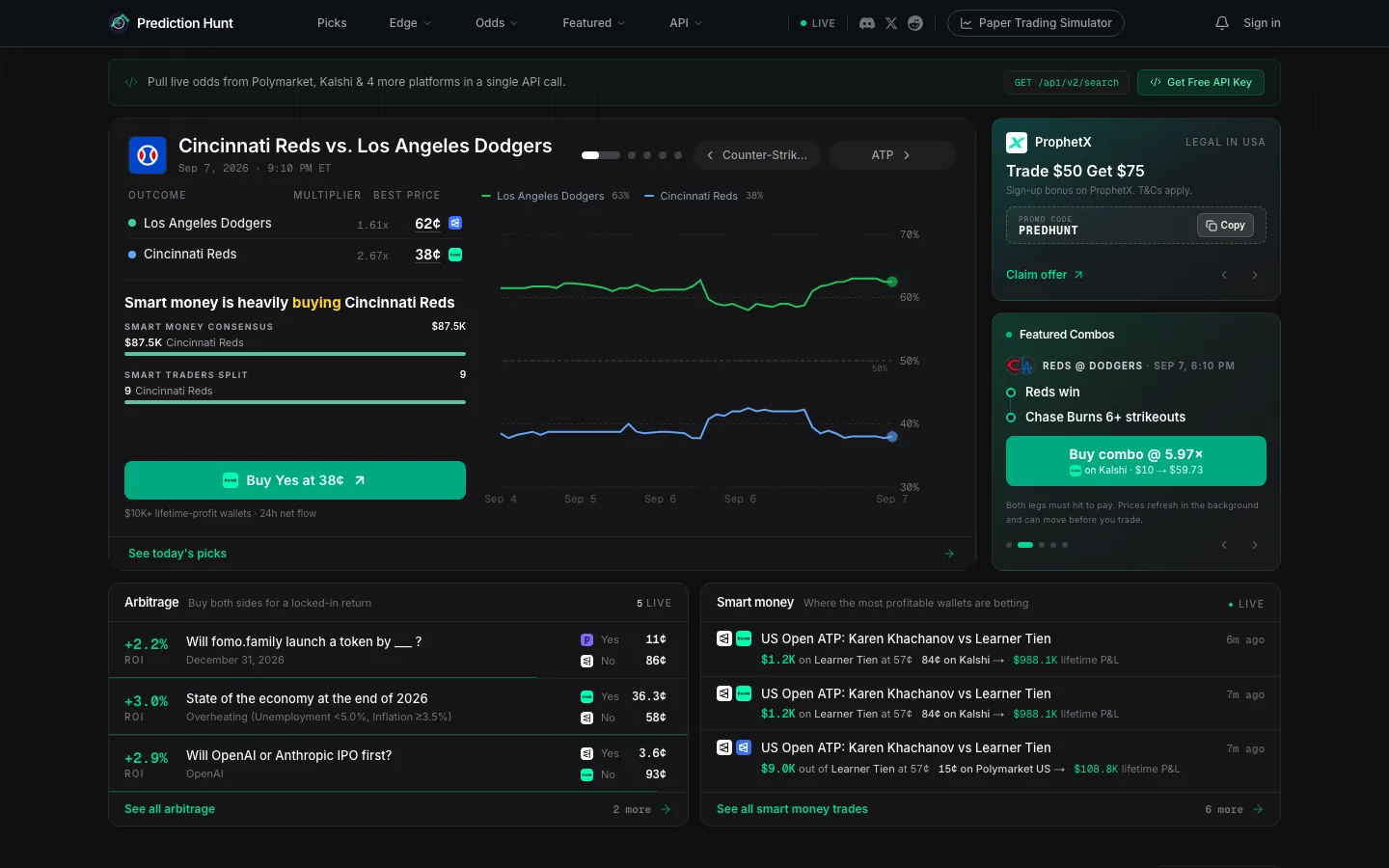
Prediction Hunt
6 venues · Executes: No · Free; paid API tiers
Odds comparison across Polymarket, Kalshi, Predict.fun, PredictIt, ProphetX and Opinion, with matched contracts and divergence flags. It shows you the gap between venues and then links out to trade it, which is the exact moment the gap closes.

Wethr
Polymarket, Kalshi, Robinhood, IBKR · Executes: No · Free + Pro
Weather markets, done properly: live METAR observations, model runs and range tools for 70+ settlement stations. A specialist tool that beats every generalist on its one vertical.

Mention Markets
Polymarket, Kalshi · Executes: No · $199/mo
Client-side transcript search over speeches, White House briefings, FOMC and earnings calls, for trading mention markets. The most expensive subscription in the census, aimed at a market almost nobody else tools for.

Metaculus
Metaculus · Executes: No · Free with account token
Not a venue and not a screen: a reputation-based forecasting platform whose aggregate is the best public calibration reference in the category. Useful as a prior on long-horizon questions, useless for a fill.
A research tool that cannot execute is not a flaw, it is a category. Just know which one you are buying, and count the tabs between the signal and the order.
Job 4 of 6 · 7 tools tracked
Arbitrage scanners
Is there a tool that finds arbitrage between Kalshi and Polymarket?
Seven tools in 288. The smallest category in the census, and the one with the widest gap between what it promises and what it delivers.
The premise is sound: the same contract routinely trades at different prices on Kalshi and Polymarket, because the two venues have different users, different funding rails and different listing speeds. That spread is the most reliable edge available to a retail trader in this category.
The problem is latency. A scanner that emails you a spread has sold you a photograph of an opportunity. Of the seven, three can actually place the order, and all three are open-source repos you run yourself.
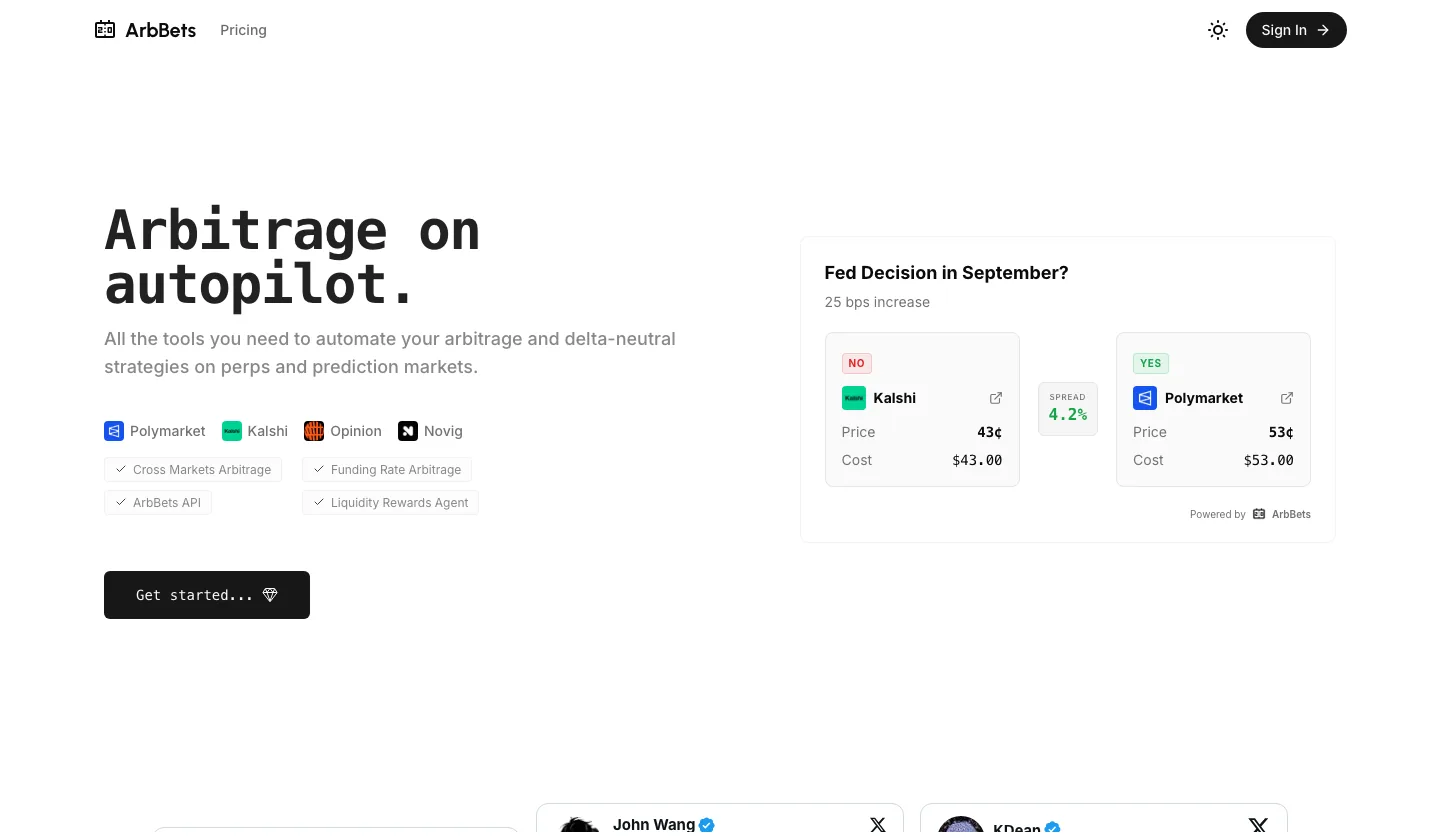

ArbBets
Polymarket, Kalshi, Opinion, Novig, sportsbooks · Executes: No · Basic $59/mo, Pro $149/mo, Premium $299/mo
The commercial option: 990+ matched pairs across five venue types with alerts and a REST API on higher tiers. It flags the gap. Closing it is on you, in another tab, at a price that has moved.

Eventarb
Kalshi, Polymarket, Robinhood, IBKR · Executes: No · Free, open source
A fee-adjusted arbitrage calculator rather than a scanner: enter the odds from each venue and it returns the real spread after costs. Free, and it does the one piece of arithmetic most traders get wrong.
poly-kalshi-arb
Polymarket, Kalshi · Executes: Yes · Free, open source
A Rust bot that trades the gap rather than reporting it, configured through environment variables with a dry-run paper mode on by default. Read the code before you fund it — that advice applies to every repo in this row.
polymarket-arbitrage
Polymarket, Kalshi · Executes: Yes · Free, open source
Python, scanning thousands of markets for both cross-venue gaps and YES+NO bundle mispricings, with risk limits and fee modelling. The bundle mispricing is the one most scanners miss entirely.
Every tool in this row exists because the two venues disagree. None of them fixes the underlying problem, which is that you are watching two books through two straws. The fix is seeing both books in one ladder, which is the last job on this page.
Job 5 of 6 · 25 tools tracked
Bots and automation
Can you automate prediction market trading?
Twenty-five tools run the strategy for you, and this is the healthiest corner of the census: most of them are open source, most of them are free, and most of them ship a paper-trading mode you should use first.
Two shapes. Frameworks you write strategies in, and finished bots that run one strategy well. The frameworks age better.
Prediction Market Toolkits
9 venues · Executes: Yes · Free (self-host); managed Pro $49/mo
A Rust execution engine with ten strategy bots — copy trading, arbitrage, sniper, market making — and venue adapters spanning Polymarket, Kalshi, Limitless, Myriad, PredictIt and Manifold. The most venue coverage of any bot in the census.
Homerun
Polymarket, Kalshi · Executes: Yes · Free, self-hosted
Write Python strategies and data sources, backtest against order-book replay, then paper or live trade on both venues. Order-book replay is the part that matters: backtesting a prediction market on close prices will lie to you about fills.

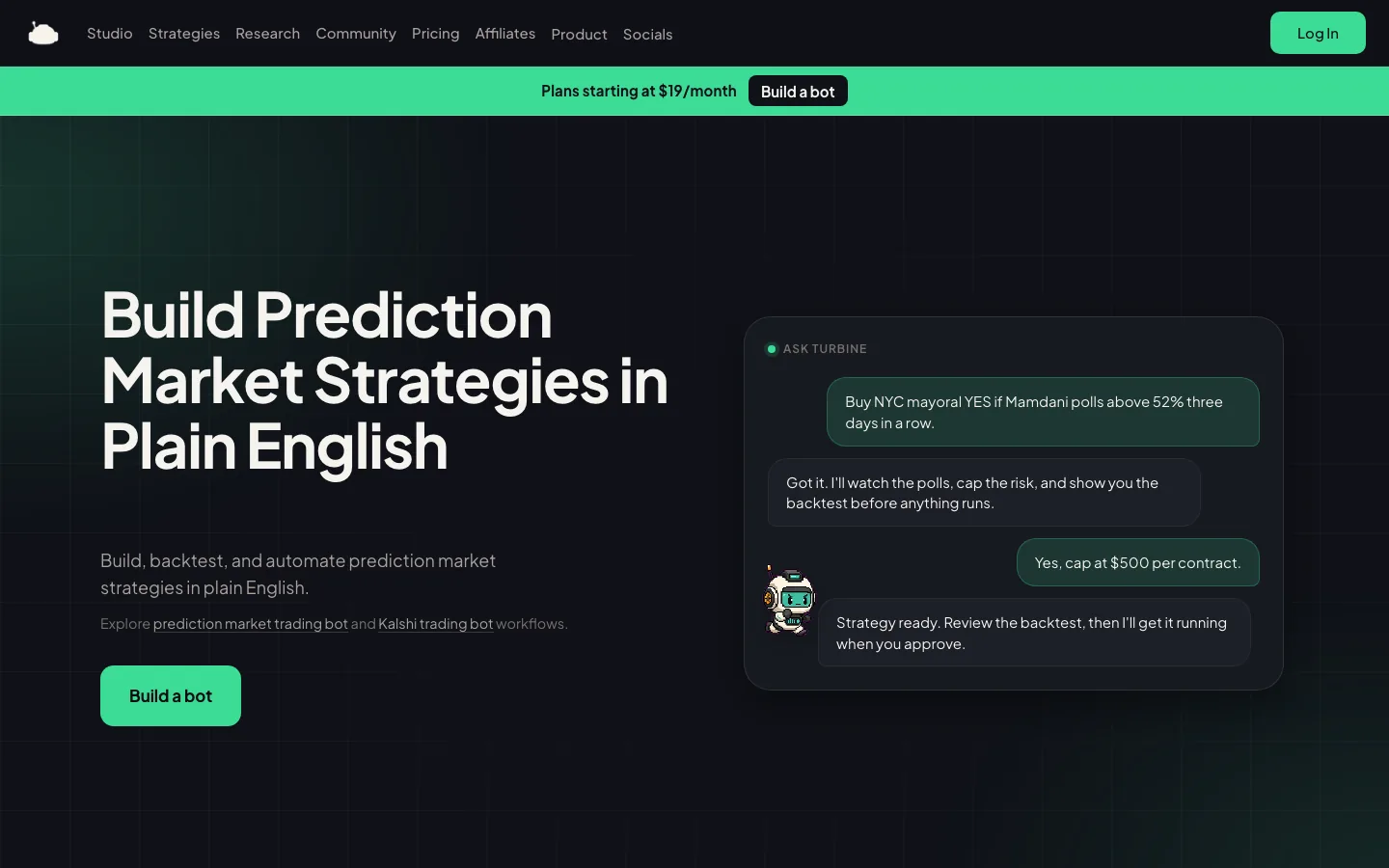
TurbineFi
Kalshi, Polymarket, Manifold · Executes: Yes · Starter $19/mo, Basic $99/mo, Pro $199/mo
The no-code option: describe a strategy in English, backtest it on 30 days of Kalshi and Polymarket data, deploy to a cloud sandbox. Thirty days is a short window to trust a strategy on. Treat the output as a hypothesis.
poly-maker
Polymarket · Executes: Yes · Free, open source
Maker-only market making on the Polymarket CLOB, quoting two-sided post-only orders on ranked political markets. Maker-side is where the economics work on Polymarket, because takers pay and makers get a rebate.
KalshiMarketMaker
Kalshi · Executes: Yes · Free, open source
An Avellaneda-Stoikov worker per market with inventory limits, selecting binary markets by volume and spread. Real quant machinery, aimed at the venue that charges makers nothing by default.
OctoBot Prediction Market
Polymarket · Executes: Yes · Free, open source
The friendliest on-ramp: web and Telegram interfaces, paper trading, self-custody keys. Its README still marks copy trading and arbitrage as work in progress and Kalshi support as planned, so buy the roadmap only if you are happy with today.
One rule for all twenty-five. Every one of these places real orders with your money, and the good ones default to paper mode for a reason. Run the paper mode until it bores you.
Job 6 of 6 · 30 tools tracked
Execution terminals
What is the best prediction market terminal?
Thirty tools let you trade rather than watch, and this is the job every other category eventually hands off to.
It is also the job with the highest mortality. Two of the terminals in the census are already gone, and a third stopped answering its own TLS handshake. Building the trade surface is harder than building the screen on top of it.
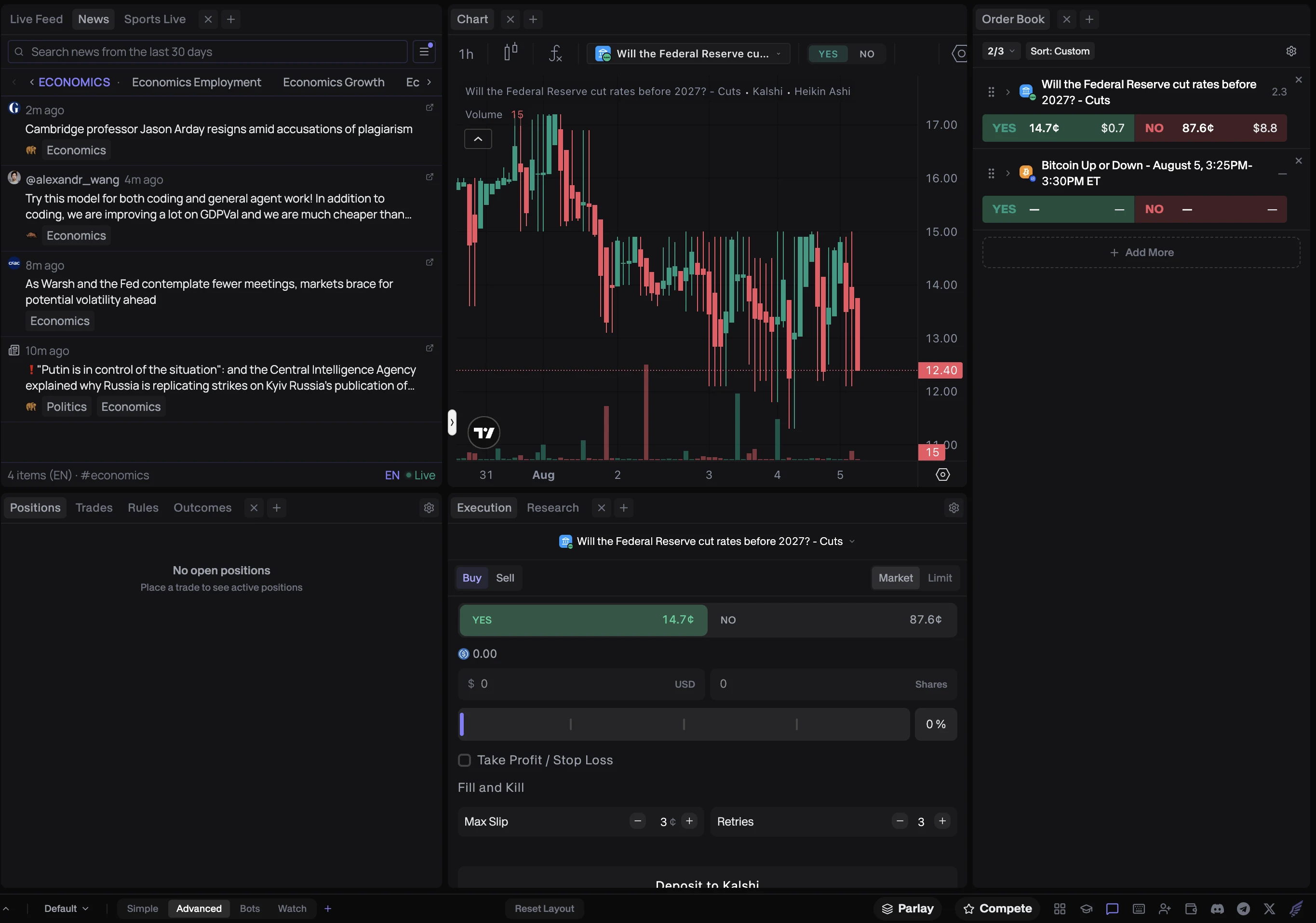
Kairos
Kalshi, Polymarket, Predict.fun · Executes: Yes · 0.01% platform fee, venue fees at cost
Ours. Three venues merged into one ladder with best bid and best ask across them, sub-second streaming data, and limit, stop-loss and take-profit orders on the ticket. One of 29 tools in the census that see more than one venue and can act on what they see.

Kalshi Pro
Kalshi · Executes: Yes · Free
The best single-venue terminal in the category, and not close: multi-market canvas layouts, a screener across roughly 2,000 markets, TradingView charts and a live trade feed. Everything a serious trader wants, on exactly one venue.

Stand
Polymarket, Kalshi · Executes: Yes · Not published
A terminal built around following whale wallets and copy trading their positions, with a Discord bot attached. Strong on the social loop, quiet on what it costs.
Sharpe Terminal
Polymarket, Kalshi · Executes: Yes · Not published
Public beta, and the order types are the reason to watch it: OCO and conditional orders, portfolio P&L and liquidity scans. Conditional orders are rare outside Kairos in this category.

Matchr
5 venues · Executes: Yes · Not published
The widest matching engine of the cross-venue terminals: it pairs equivalent events across five venues and shows the best price. Execution currently routes through Polymarket only, so the coverage is a view, not yet a fill.

Betmoar
Polymarket · Executes: Yes · Free, no platform fee
The Discord-native option, and the only tool in the census tracking UMA oracle disputes on Polymarket resolutions. One venue. Our longer take: the Betmoar review.
Pick your venues on fees and liquidity. Trade them from one screen. The whole terminal question is covered at length on the best prediction market terminals page.
Which prediction market tools have shut down?
Twenty-one of the 288, or 7%, were dead or unreachable when we last checked every link. That number is the most useful thing on this page, because no directory publishes it and every directory keeps listing the corpses.
| Tool | Category | What happened |
|---|---|---|
| Fireplace | Terminal | Raised $1.5M in February 2026, announced shutdown 10 August. Trading ended 15 August; withdrawals and migration close 30 September 2026, 23:59 UTC. |
| Dome | Data API | Acquired by Polymarket. All Dome APIs reached end of life on 28 April 2026. |
| Metaforecast | Dashboard | Shut down. The cross-platform forecast aggregator is no longer maintained. |
| Verso | Terminal | Unreachable: both domains failed the TLS handshake at our last check, with the domain still registered and DNS live. Not a parking page — a broken one. |
| Polymarket Agents | AI agents | Shut down. Polymarket’s own agent framework is no longer published. |
| py-clob-client, clob-client, rs-clob-client | SDKs | All three original Polymarket CLOB clients retired, superseded by the unified py-sdk and ts-sdk. |
If you still hold a position on Fireplace
The deadline is 30 September 2026 at 23:59 UTC, and it is real. After that the app goes offline. We wrote the migration path up separately: how to move off Fireplace without selling a position.
The pattern in the graveyard is worth naming. The tools that died were mostly single-venue screens and thin wrappers. The tools that survived either own their data pipeline or execute. Building a view is cheap, which is why 288 teams did it. Building a fill is not.
Which prediction market tools cover both Kalshi and Polymarket?
Seventy of the 288. Twenty-nine of those can also place the order, and here they are — the complete list, which as far as we know is not published anywhere else.
| Tool | Venues | Status | Open source | Pricing |
|---|---|---|---|---|
| PMXT | 15 | Live | Yes (MIT) | Free |
| Prediction Market Toolkits | 9 | Live | Yes | Free self-hosted; managed Pro $49/mo |
| CCXT (prediction module) | 6 | Live | Yes (MIT) | Free |
| Matchr | 5 | Live | No | Not published |
| dr-manhattan | 5 | Live | Yes | Free |
| TradeFox | 5 | Unverified | No | 0.75% to 0.95% net per trade |
| CloddsBot | 4 | Live | Yes | Free |
| TatorTrader | 4 | Live | No | Not published |
| okbet | 4 | Live | No | 1% per trade, 0% with $OK |
| Kairos | 3 | Live | No | 0.01% platform fee |
| PredictOS | 3 | Live | Yes | Free |
| TurbineFi | 3 | Live | No | $19 to $199/mo |
| sports-skills | 3 | Live | Yes | Free |
| OkayBet | 3 | Live | Yes | Not published |
| Converge | 3 | Unreachable | No | Not published |
| Polysights | 2 | Live | No | Free |
| Homerun | 2 | Live | Yes | Free |
| Stand | 2 | Live | No | Not published |
| Sharpe Terminal | 2 | Beta | No | Not published |
| Simmer | 2 | Live | Yes | Free tier; Kalshi needs Pro |
| ClawForge | 2 | Live | Yes | Free |
| PolyOracle | 2 | Live | No | Not published |
| Polymarket Kalshi Weather Bot | 2 | Live | Yes | Free |
| Elastics | 2 | Beta | No | Not published |
| future fun | 2 | Live | No | Not published |
| poly-kalshi-arb | 2 | Live | Yes | Free |
| polymarket-arbitrage | 2 | Live | Yes | Free |
| prediction-market-arbitrage-bot | 2 | Live | Yes | Free |
| Fireplace | 2 | Shut down | No | Closes 30 Sep 2026 |
Two things stand out in that table. Sixteen of the 29 are open source — the cross-venue problem has largely been solved by people giving the solution away. And fourteen of them will not tell you what they cost.
The other thing worth noticing is what is missing: almost every well-known name in this category. The trackers, the screens, the dashboards, the AI agents. They are excellent at their job and they are not in this table, because their job ends one step before the trade.
Why do most prediction market tools only cover one venue?
Because Polymarket settles on a public blockchain and Kalshi does not.
Every Polymarket trade is on Polygon, readable by anyone with an RPC endpoint and no permission from anybody. That is why 240 of the 288 tools in this census are built on it, why the whale-tracking category has 42 entries, and why the best free tools in the category are all Polymarket tools.
Kalshi publishes an excellent API — REST, WebSocket and FIX, with no auth required just to read market data — but it is an API, not a chain. You integrate it deliberately. Only 82 tools have, and 12 of those cover Kalshi alone.
The result is a tooling ecosystem weighted toward the venue that is easiest to read rather than the venue with the flow. If your workflow lives entirely inside a Polymarket-only tool, you are trading with the larger book switched off.
If you have already picked your venue, the venue-specific shortlists go deeper than this page can: the best Polymarket tools for the 240, Kalshi tools for the 82, and Polymarket analytics for the dashboards specifically.
Are prediction market tools free?
Mostly, and more than you would guess. 112 of the 288 are free outright and 109 are open source. This is a category where the best whale tracker, the best arbitrage calculator and the widest multi-venue SDK all cost nothing.
| What it charges | Tools | Share |
|---|---|---|
| Free, with no paid tier at all | 148 | 51% |
| Publish no price anywhere | 81 | 28% |
| Free to start, paid tier above it | 40 | 14% |
| Charge a per-trade fee | 17 | 6% |
| Name a monthly or weekly price | 16 | 6% |

Where money does change hands it takes four shapes. Flat subscriptions, from $9.99 a week to $299 a month. Metered API tiers. Per-trade fees, from 0.5% up to 1%. And token schemes, where holding the project token cuts your fee.
Eighty-one tools — 28% of the census — publish no price anywhere. No page, no tier list, nothing. That is not always a red flag; several are pre-revenue and genuinely free today. But when a tool with no published price asks for wallet permissions, the price is the question to ask first.
What tools do professional prediction market traders use?
Fewer than you would think, and none of them are the directories.
A working stack is four things. A data layer you can query historically, so you can test a claim instead of feeling it. A screen for finding candidates. Something that watches the flow. And a terminal that can act on all of it without a browser tab in between.
What professionals do not do is run six single-venue tools and reconcile them by eye. The reconciliation is the job, and it is the job every tool in the census either does for you or quietly leaves on your desk.
The test that thins this list fast
Open any tool on this page and ask two questions. Can it see both Kalshi and Polymarket? Can it place the order? Seventy of 288 pass the first. Twenty-nine pass both. Every other tool in the category is a component, not a workflow — useful, often excellent, and always one tab away from the fill.
What is the difference between a prediction market tool and a terminal?
A tool answers a question. A terminal takes the trade.
That distinction is not semantic, it is the 138 number at the top of this page. Nearly half of everything built in this category cannot place an order, which means nearly half of it ends its job by handing you back to a venue web app — the interface you bought the tool to avoid.
Kairos is on the other side of that line. Kalshi, Polymarket and Predict.fun in one book, global best bid and best ask, sub-second data, advanced order types, low-latency execution. The power of an institutional trading desk, on your laptop.
Use the screens. Use the trackers. Read the census and take the best of all 288. Then trade them from one screen.