Quick answer
There is no single best prediction market app, because each wins a different category. Kalshi wins on scale and regulation, Polymarket on breadth and taker pricing, Robinhood on how fast you can start, Novig on cost, because pre-game sports trades there are free. DraftKings wins on flat fees, ProphetX on paying only when you win, PredictIt on political markets. Kairos wins on professional trading: the terminal and cross-venue API you graduate to once one app stops being enough.
Prediction markets are the derivatives layer on top of the entire world. Eight apps now compete to sell you access to it.
Every ranking of them you will find scores the same things: signup bonus, app polish, promo code. Those are the things affiliates get paid on. None of them is what determines whether you make money.
Three things do. What the venue charges you to trade. How deep the book is when you need out. Whether a federal regulator is standing behind it.
So there is no number one here, and any list that gives you one is selling something. These eight are not competing for the same job. Each wins a category outright, and the useful question is which category your next trade falls into.
One category every other roundup skips entirely: what you use once you are past tapping Yes on a phone. Desktop, order books side by side, real order types, an API. That section is further down.
| App | Wins on | Status | Funding | Taker fee | Maker fee |
|---|---|---|---|---|---|
| Kalshi | Scale and regulation | CFTC-designated exchange | USD | 7% × (1 − P) of stake | None by default |
| Polymarket US | Regulated U.S. access | CFTC-designated exchange | USD | 6% × (1 − P) of stake | Rebate paid to you |
| Polymarket (global) | Breadth and taker pricing | Offshore, U.S. close-only | Crypto | 4% to 7% × (1 − P) by category | None |
| Kairos | Professional cross-venue trading | Terminal, not a venue | Via your venue accounts | Free | Free |
| Robinhood | Getting started | Broker routing to exchanges | USD | 10% × (1 − P) plus $0.01/contract | Same |
| DraftKings | Simple, flat fees | Introducing broker | USD | $0.01 to $0.02 flat per contract | Same |
| ProphetX | Paying only when you win | CFTC-designated exchange | USD | 2% of net gains per market | 2% |
| Novig | Cheapest sports fees | CFTC-designated exchange | USD | Free pre-game; 3% × P(1−P) live | None |
| PredictIt | Long-run political markets | CFTC no-action relief | USD | 10% of profit + 5% withdrawal | Same |
What each prediction market app wins on
Wins on scale and regulation
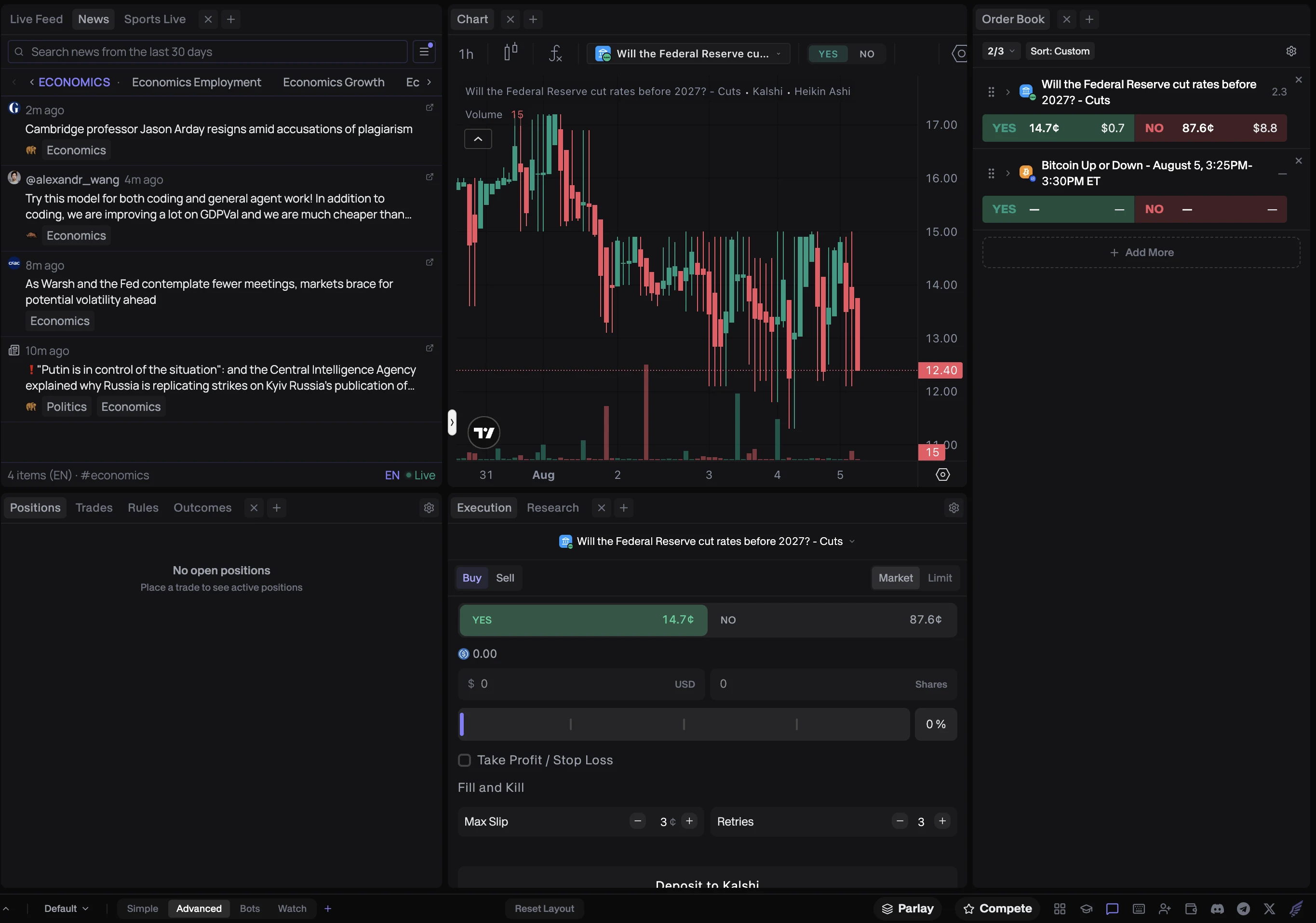
Kalshi
Kalshi wins on sheer size and on regulatory standing. It has been a CFTC-designated contract market since November 2020, the same licence class as the U.S. futures exchanges, and it is now the largest prediction market in the world by volume, at roughly $135bn traded in the first seven months of 2026 against $61bn on Polymarket's global venue. Read that with the mix in mind: Pew puts sports at about 80% of Kalshi's volume against 39% of Polymarket's. Kalshi is winning the sports book, not the politics one.
You fund it in dollars from a bank account or card, ACH and wires are free, and it issues tax forms. There is no settlement fee and no membership fee. In a category that spent a decade offshore, that is the whole pitch.
Two honest catches. The fee does not work the way people assume: per dollar deployed it comes to 7% × (1 − P), so longshots are the expensive trades and favourites are nearly free. And the state picture is unsettled. Kalshi is fighting more than twenty states in court, and judges in Nevada and Michigan have ordered it to geofence sports markets. Check what is live in your state before you plan around it.
Strengths
- CFTC-designated exchange, largest venue by volume
- USD funding, free ACH and wires, no crypto wallet needed
- No fee at all on resting orders, plus a real public API
Tradeoffs
- Taker fees hit longshots hardest: 6.65% of stake on a 5¢ contract
- State availability is contested and moving; sports is geofenced in some states
- Native interface is built for browsing, not trading
Wins on breadth and taker pricing
Polymarket
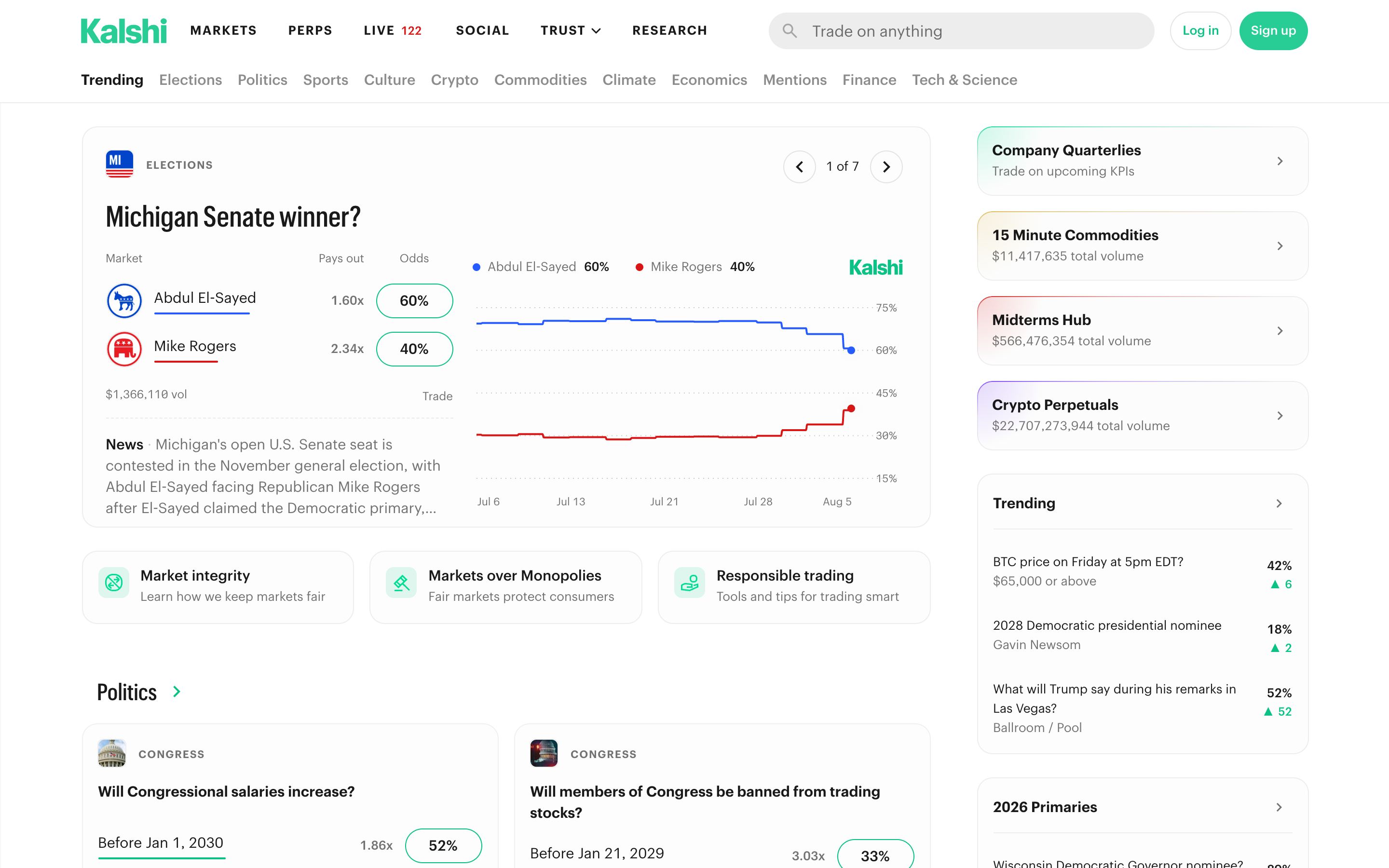
Polymarket is really two venues now, and conflating them is the most common mistake written about this category. The global site is the offshore, crypto-settled one that built the brand. U.S. users can close existing positions there but cannot open new ones. Polymarket US is a separate CFTC-designated exchange, live at polymarket.us, funded in plain dollars by bank transfer or debit card.
The global book is where the depth and the range live. It lists faster than anyone: a story breaks in the morning and there is a market on it by lunch, because contracts do not need clearing first. Politics, geopolitics, weather, esports, even what a politician will say in a speech.
On price it is the sharpest venue here. Makers are never charged on either entity, and Polymarket US goes further and pays makers a rebate. Its taker rate of 6% × (1 − P) undercuts Kalshi's 7%, and on the global site geopolitics markets carry no taker fee at all.
Strengths
- Cheapest taker rate of the major U.S. venues, and a rebate for makers
- Widest market coverage and fastest listing on the global book
- Polymarket US takes dollars, so no crypto is needed for the regulated venue
Tradeoffs
- The global site is close-only for U.S. traders; the two entities are easy to confuse
- Global funding is USDC, which is friction if you hold no crypto
Wins on professional cross-venue trading
Kairos
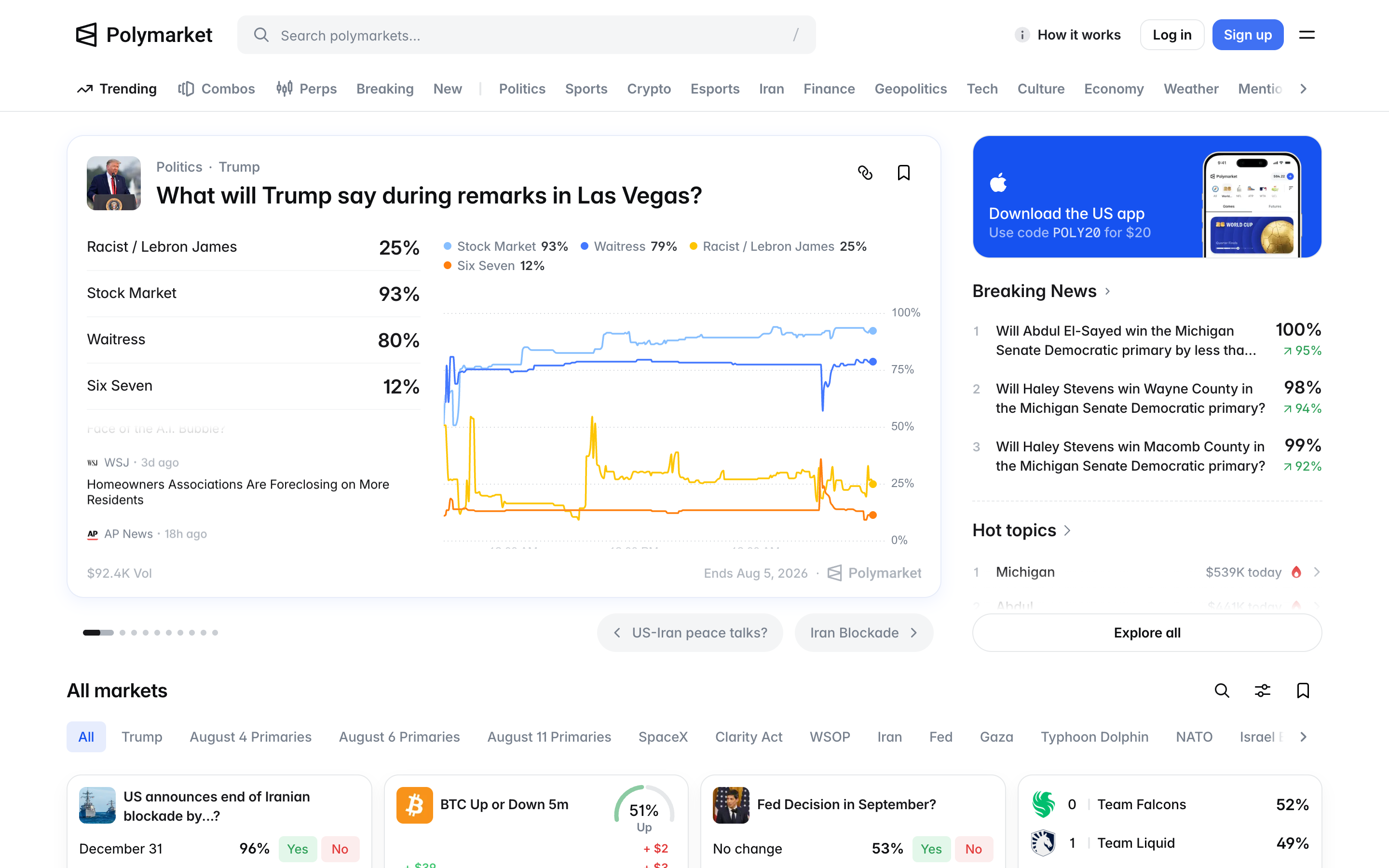
Kairos is not a venue. It is the terminal above them, and it is the one product on this list nobody opens first. You graduate to it, moving from the app that was easiest to sign up for to the one built for how you actually trade once size and frequency start to matter.
The reason to make that jump is price. The same contract does not trade at the same price on Kalshi and Polymarket, and that gap is the most reliable edge available to a retail trader in this category. You cannot see it from inside either app. Kairos puts the books side by side with the global best bid and best ask, sub-second data, and an execution ticket carrying take-profit, stop-loss and fill-and-kill slippage controls.
Then there is the API, which is the part serious traders come for. REST and WebSocket, covering execution, market data and trader intelligence across every venue Kairos ingests. One integration instead of one per exchange, with each venue's auth and quirks already absorbed. It is non-custodial if you want it to be: request an order intent, sign it with your own key, submit. And an order fee-quote endpoint returns the platform fee, the venue fee and the all-in cost before you commit, which given everything above is the number that decides the trade.
The technology that wins on Wall Street, pointed at prediction markets and handed to individual traders.
Strengths
- Books side by side across every venue, with global best bid and best ask
- Sub-second data, advanced order types, take-profit, stop-loss, fill-and-kill
- One REST and WebSocket API for execution across all venues, non-custodial by design
- Free to use
Tradeoffs
- A terminal rather than an exchange, so you still hold accounts at the venues
- Built for active traders; more than you need if you place one trade a month
Wins on getting started
Robinhood Prediction Markets
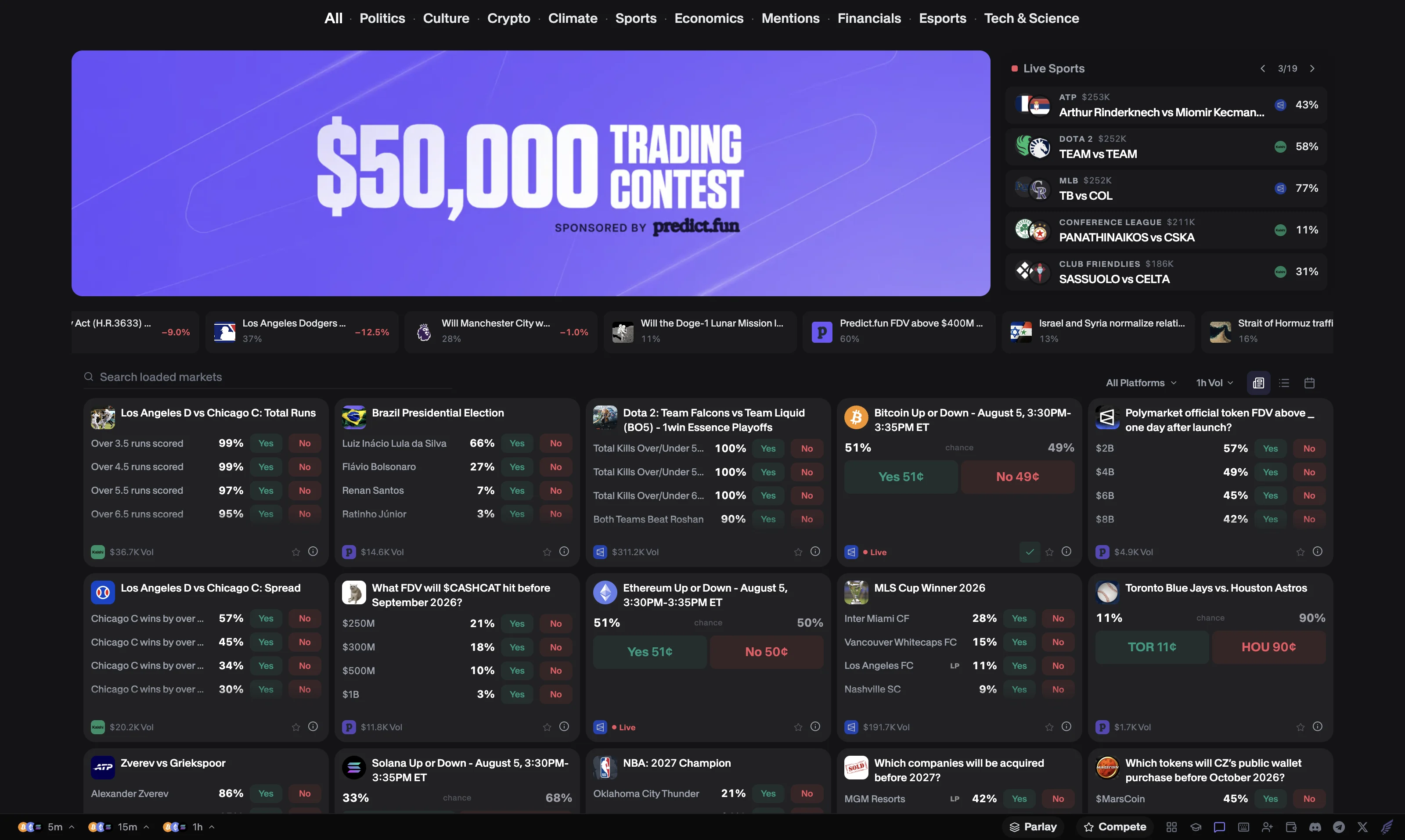
Robinhood put event contracts next to the stocks its users already own, and distribution did the rest. For a casual trader with a funded Robinhood account, this is the shortest path from curiosity to a position.
It is also, by a distance, the most expensive way to take one. Robinhood is a broker rather than an exchange. It routes your order to KalshiEX and others, and charges its own commission of 10% × P × (1 − P) per contract on top of a flat $0.01 per contract from the exchange. Gold halves the commission but not the flat fee.
That flat component is what does the damage. A $1,000 position at 5¢ costs roughly $295 in fees here against $67 on Kalshi for the identical trade. It is the easiest place to start and the first place you should outgrow.
Which is the honest way to read this whole list. Start wherever the friction is lowest. Move as soon as the cost of staying starts to outweigh the convenience.
Strengths
- Zero new-account friction
- Familiar interface, instant funding
Tradeoffs
- Far and away the most expensive venue here, especially on cheap contracts
- Narrow market selection, no public API, mobile-only trading
Wins on simple, flat fees
DraftKings Predictions
DraftKings brought event contracts to an audience that already bets, in an app they already have. If you came from sports betting and want the same feel with an exchange underneath, this is the softest landing.
Read the structure carefully though. DraftKings Predictions is a registered introducing broker. The exchange itself is a sibling company, Railbird, designated by the CFTC in June 2025. Its fee is refreshingly simple: a flat cent or two per contract, all in, rather than anyone's quadratic.
The catch is coverage. DraftKings offers all markets in only 18 states; another 13 get financial markets only, 18 get everything except sports, and two get nothing at all. Check your state first, because the "38 states" figure circulating online is stale.
Strengths
- Familiar to sportsbook users
- Flat, predictable per-contract fee
Tradeoffs
- Availability varies sharply by state; sports is excluded in 18 of them
- Sports-weighted, and no public API
Wins on paying only when you win
ProphetX
ProphetX is a sports-first exchange where you trade against other users rather than a house line. It converted from a state-licensed betting exchange into a full CFTC-designated exchange in June 2026 and went nationwide, so it now clears its own trades.
Its fee is charged on outcome, not on entry: 2% of net gains per market on straight trades, and nothing at all on parlays. Lose and you pay nothing. That is a different bargain from the per-contract venues, and it favours traders who win rarely but big.
Outside sports there is nothing here. That is by design. Available in 49 states, excluding Nevada.
Strengths
- Peer-to-peer pricing with no house on the other side
- Pay only on winnings, and nothing on parlays
Tradeoffs
- Sports only
- Not available in Nevada
- Thinner books than the majors
Wins on the cheapest sports fees
Novig
Novig built its identity on removing the vig, and it is the one venue on this list that delivers on a zero-fee claim. Pre-game straight trades cost nothing on either side of the book: no taker fee, no maker fee, through the app and through the API. That is the cheapest schedule anywhere in this category.
Live trading costs a taker 3% × P × (1 − P) per contract, parlays 10%, and makers are free across every trade type. It completed its own conversion to a CFTC-designated exchange in August 2026.
Same limitation as ProphetX: it is a sports product. Judge it against sportsbooks, not against Kalshi. Nationwide except Nevada, Arizona and Michigan, and it requires you to be 21.
Strengths
- Free on pre-game straight trades, both sides
- Makers never pay, on any trade type
- Public REST, WebSocket and GraphQL APIs
Tradeoffs
- Sports only, and 21+ rather than 18+
- Not available in Nevada, Arizona or Michigan
- Smaller user base means thinner books
Wins on long-run political markets
PredictIt
PredictIt is the original. It ran U.S. political markets under CFTC no-action relief years before any of this was mainstream, and it is still where a certain kind of politics trader lives, currently across around 200 open markets, all political, no sports.
Its famous constraints have quietly loosened. The 5,000-trader cap per contract is gone, and the $850 position limit everyone still cites was replaced in July 2025 by the federal campaign-contribution limit, currently $3,500 and inflation-adjusted. Eligibility runs on U.S. person status and a valid SSN or ITIN rather than on your state.
What has not changed is the economics: 10% of every profitable exit, plus 5% to withdraw your own money. Historically important. Economically outclassed.
Strengths
- Long-running political markets
- Established trader community
- Position caps far higher than commonly reported
Tradeoffs
- 10% of profits plus a 5% withdrawal fee
- Politics only, and no sports
- Requires a U.S. SSN or ITIN
What is the best prediction market app?
Wrong question, and it is the one every other list on this page answers. Naming a single winner across eight venues that do different jobs tells you nothing about the trade in front of you.
Ask instead what you are optimising for. Size and regulatory standing point to Kalshi. Breadth of markets and the cheaper taker rate point to Polymarket. Pre-game sports at zero cost points to Novig. A first trade in the next two minutes points to Robinhood, expensively.
A stock trader does not pick a favourite brokerage and stop thinking. They ask where the fill is better. Prediction markets are fragmented enough that the answer changes trade by trade.
What do prediction market apps charge to trade?
Two models. Commission venues charge an explicit fee per contract on execution, which is how Kalshi and Robinhood work. Spread venues charge nothing and make you cross the bid-ask instead, which is Polymarket's model. Neither is free. One is just easier to see.
Kalshi and Polymarket US charge the same shape: Θ × contracts × P × (1 − P), where Θ is 0.07 on Kalshi and 0.06 on Polymarket US. Almost everyone reads that formula wrong. Per contract, yes, the fee peaks at 50¢ and falls toward both tails. But you do not buy a fixed number of contracts. You deploy a fixed number of dollars, and a 5¢ contract buys nineteen times as many of them as a 95¢ one.
Substitute contracts = stake ÷ P and the P(1−P) term collapses. What the trade costs per dollar you put at risk is:
A straight line. No peak in the middle. On Kalshi a 5¢ longshot costs 6.65% of your stake and a 95¢ favourite costs 0.35%. Nineteen to one, in the opposite direction from the received wisdom. Longshots are the expensive trades. Every venue using this formula behaves the same way.
Then there is the side you trade on, which matters more than the venue. Kalshi charges makers nothing by default, because its maker formula carries a multiplier that defaults to zero on standard markets. Polymarket US goes further and pays makers a rebate. Cross the spread and you pay; rest an order and you trade free or get paid.
The one to watch
Robinhood is not an exchange. Robinhood Derivatives is a broker routing to KalshiEX and others, and it charges its own commission of 10% × P × (1 − P) per contract, halved with Gold, on top of a flat $0.01 per contract passed through from the exchange. That flat component is brutal on cheap contracts, because a fixed stake buys 20,000 of them at 5¢ against 1,052 at 95¢. A $1,000 position at 5¢ costs about $295 in fees on Robinhood against $67 on Kalshi. Convenience has a price, and on longshots it is roughly 30% of your stake.
Cost calculator
What this trade actually costs you
| Venue | Contracts | Fee | % of stake |
|---|---|---|---|
| KalshiTaker0.07 × C × P × (1 − P), rounded up | 2,000 | $35.00 | 3.50% |
| Kalshi, resting orderMakerNo fee by default on standard markets | 2,000 | $0.00 | 0.00% |
| Polymarket USTaker0.06 × C × P × (1 − P) | 2,000 | $30.00 | 3.00% |
| Polymarket US, resting orderMaker−0.0125 × C × P × (1 − P), paid to you | 2,000 | +$6.25 | +0.63% |
| RobinhoodTaker10% × P × (1 − P) × C, plus $0.01 per contract | 2,000 | $70.00 | 7.00% |
Drag the price to the left and every taker row climbs. A cheap contract buys more contracts per dollar, so on a fixed stake the fee works out to Θ × (1 − P), worst on longshots and near zero on favourites. Robinhood climbs fastest because it adds a flat $0.01 per contract on top of its commission. Green rows are rebates: Polymarket US pays makers rather than charging them. Figures are each venue’s published schedule as of 5 August 2026, for one opening trade on a standard market. Not included: the spread you cross to get filled, which on a thin book costs more than any fee here.
The number nobody quotes
Fees are the cost you can see. The spread is the cost you cannot. Crossing a two-cent spread on a 50¢ contract costs 4% of your stake before a single fee is charged, more than the fee on any venue here. The venue with the tightest book usually beats the venue with the lowest fee, which is why price discovery across venues matters more than any fee schedule.
Which prediction market app has the best odds?
Whichever one is mispriced at the moment you want to trade. The same contract routinely trades at different prices on Kalshi and Polymarket, because the two venues have different users, different funding rails and different listing speeds.
That spread between venues is the most reliable edge available to a retail trader in this category. It requires exactly one thing: seeing both books at once. From inside either app, the gap is invisible.
This is the argument for a prediction markets trading terminal rather than a favorite app. One screen. Global best bid and best ask. Route to the better price.
What do professional prediction market traders use?
Not the apps on this list. Every venue here ships a phone-first product built for browsing markets and tapping Yes or No, and every other roundup of them is written as if that is the whole category. It is not.
It is also a category that consolidates. Fireplace, a cross-venue terminal that raised $1.5m in February 2026, announced on 10 August that it is closing: trading there ended 15 August and the app goes offline after 30 September. Anyone still holding a book on it should read how to migrate off Fireplace without selling a position before the deadline.
Professionals trade prediction markets the way they trade anything else: on a desktop, from a terminal. Multiple books visible at once. A chart with real indicators next to the order ticket instead of three taps away. Limit orders, take-profit, stop-loss, and slippage controls on a fill. Positions and news in the same field of view as the market you are about to hit.
That is a different product category from a prediction market app, and it is the one Kairos is in. If you want the long version, we wrote it up separately: what a prediction market terminal is, and the terminals worth using. The wider field around them, every API, tracker, screen and bot built on these venues, is in our census of the best prediction market tools: all 288, with what each covers and whether it can execute.
The mobile tell
A quick way to judge how seriously a venue takes active traders: open it on a laptop. If the desktop site is the phone app stretched wide, with no order book depth, no advanced order types and no keyboard flow, it was built for people placing a bet, not for people managing a position. Run that test and this list thins out fast.
Which prediction market app has the best API?
This is where the field separates fastest, and where the sportsbook-built products give themselves away. Robinhood, DraftKings and FanDuel publish no public trading API at all. Robinhood does not even let you trade from a desktop browser. The exchanges built by exchange people all do.
| Venue | Public API | Protocols | Auth for market data |
|---|---|---|---|
| Kalshi | Yes | REST, WebSocket, FIX | None required |
| Polymarket (global) | Yes | REST, WebSocket | None required |
| Polymarket US | Yes | REST, WebSocket, FIX | None for reads; Ed25519 to trade |
| Novig | Yes | REST, WebSocket, GraphQL | Documented |
| ProphetX | Yes | REST, trading and market data | Documented |
| PredictIt | Yes | REST | None; attribution required |
| Robinhood | No | None | None |
| DraftKings | No | None | None |
| FanDuel | No | None | None |
| Kairos | Yes, one across every venue | REST, WebSocket | Key-based |
The catch with going direct is that you do not integrate one API, you integrate several, each with its own auth, rate limits, symbology and websocket semantics, and none of them shows your positions on the others. That work is identical for everyone who does it, which is why it is worth doing once rather than each.
Kairos is that layer: one prediction markets trading terminal and one REST and WebSocket API covering execution, market data and trader intelligence across every venue it ingests. Non-custodial if you want it: request an order intent, sign it with your own key, submit. Full reference on the institutional prediction market API.
Are prediction market apps legal in the US?
The federally designated ones operate legally nationwide. Kalshi, Polymarket US, ProphetX and Novig are all CFTC-designated contract markets, and Robinhood and DraftKings reach the same contracts through registered brokers.
Legality is not the same as safety, and both are worth understanding before you fund an account. The full breakdown of who regulates what, and what that protects, is on our is Kalshi legit page.
Should you use more than one prediction market app?
Yes, and it is not close. Holding accounts at Kalshi and Polymarket costs you nothing and buys you two things: the better price on every trade, and a market to trade when the other venue has not listed it.
The friction is real, though. Two apps, two balances, two books, and a price gap that closes in seconds while you tab between them.
That fragmentation is the problem Kairos was built to delete. Kalshi and Polymarket in one book, sub-second data, advanced order types, low-latency execution. The power of an institutional trading desk, on your laptop.
Pick your venues on fees and liquidity. Trade them from one screen.