Quick answer
Fireplace announced on 10 August 2026 that it is shutting down. Two dates matter and the announcement only gave you one. Trading on Fireplace ends 15 August 2026, and the app goes offline after 30 September 2026, 23:59 UTC. You do not have to sell anything: Fireplace will migrate your open positions and your entire cash balance on-chain to your own Polymarket wallet in one step. Migrate, do not liquidate. Then pick the terminal you trade from next.
Aug 15
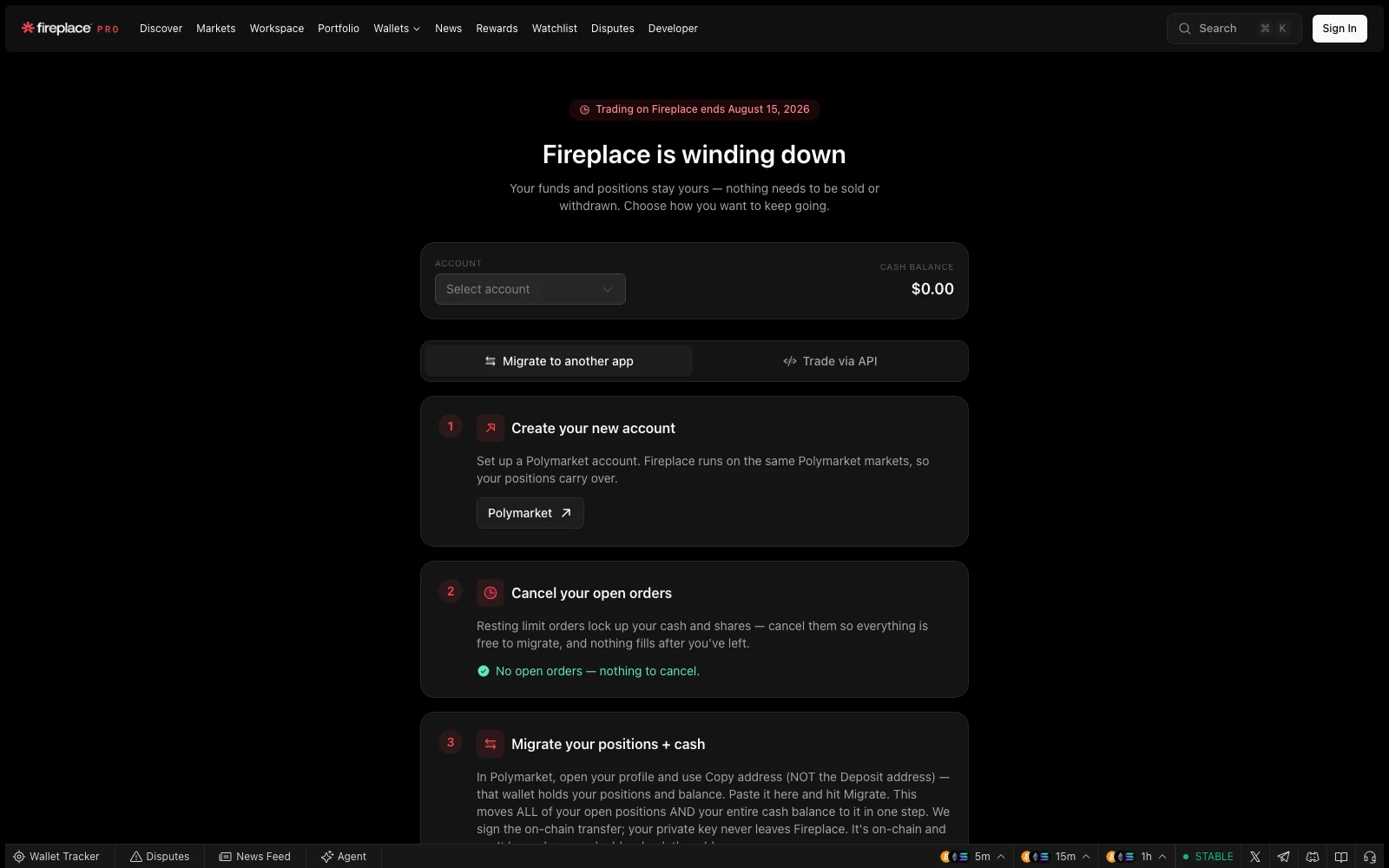
Trading on Fireplace ends. This date is on its wind-down screen, not in the announcement.
Sept 30
23:59 UTC. The app goes offline. Migrate, export and reach support before this.
Sell nothing
Positions and cash migrate on-chain to your own Polymarket wallet in one transfer.
Fireplace is shutting down. The team announced it on X on the morning of 10 August 2026.
The site stays open until the end of September so you can close positions, withdraw funds, and export your account. Please do it before September 30, 23:59 UTC.
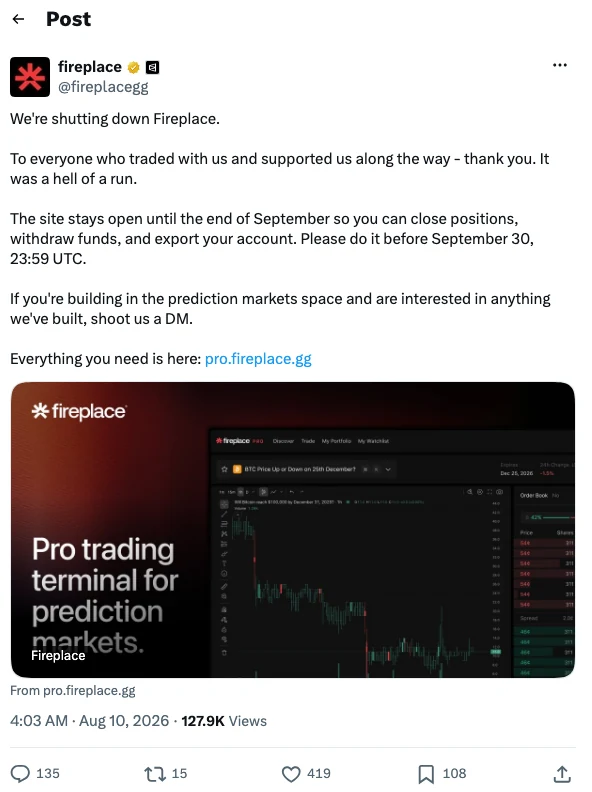
The announcement is not the whole story
The post gives one date, 30 September. Fireplace's own wind-down screen gives an earlier one: trading ends 15 August 2026. It also says something the post does not, and it is the thing that saves you money. Nothing needs to be sold. Your positions and cash migrate to your own Polymarket wallet in a single on-chain transfer. Read the next section before you close a single ticket.
Time left
Trading on Fireplace ends 15 August 2026. Migration stays open until 30 September.
days
hours
minutes
Dates as published by Fireplace on 10 August 2026, on its wind-down screen and in its announcement. Your own venue accounts are not affected by either one.
Fireplace was not a bad product. It launched publicly on 27 January 2026, raised a $1.5m pre-seed in February led by Frachtis with White Star Capital, carried the Polymarket builders badge, and had more than 30,000 traders on its waitlist before it opened the doors. Its co-founder and CTO Akshay Rajagopal put the thesis plainly: prediction markets needed their own Bloomberg Terminal.
He was right about that. Kairos is built on the same conviction. The category is real, the fragmentation is real, and a trader working three venues in three browser tabs is a trader leaving money on the table.
Being right about the problem and having runway to solve it are two different things. What matters this month is your balance.
What to do, in order
Fireplace has built a migration flow and it does the work for you. Its own three steps, in its own order:
| # | Do this | Why |
|---|---|---|
| 1 | Open a Polymarket account | Fireplace runs on the same Polymarket markets, so your positions carry over intact rather than being sold and rebought. |
| 2 | Cancel your open orders | Resting limit orders lock up cash and shares. Cancel them so the balance is free to move and nothing fills after you have gone. |
| 3 | Migrate positions and cash | In Polymarket use Copy address, not the deposit address, then paste it into Fireplace and hit Migrate. One transfer moves every open position and your whole cash balance. |
- Export your history yourself. The migration flow does not do it for you, and your fill record and cost basis go down with the app. You will want both at tax time.
- Ask support anything you need to ask now. Fireplace says plainly that it cannot help once the app is offline.
- If you traded Kalshi through Fireplace, check that side separately. The published migration path covers Polymarket positions and cash. Kalshi is not part of it, so confirm with support how your Kalshi exposure was held before you assume it moves.
Do not wait
Trading ends 15 August, which is days away, not weeks. The migration window runs longer, to 30 September, but a wind-down engineering team is a shrinking one and support disappears with the app. Do this in the first week, not the last.
What panic-selling your book would cost you
The expensive mistake this month is reading the word "shutdown" and liquidating everything on Friday. Put a number on that mistake before you make it.
Think about what you are holding. The US midterms resolve on 3 November 2026. Fed decisions, playoff brackets, the whole Q4 calendar. Sell those in August and you are selling into whatever bid happens to be there on the day you click, weeks before the event that was supposed to pay you.
When a contract resolves you are paid $1 or $0 and you cross no spread at all. When you exit early you sell to a bid that sits below the mid. That difference is what an unnecessary exit costs, and you would pay it on every position at once.
Put numbers on it. A $10,000 book spread across markets quoting 2 cents wide around 50 cents costs roughly $100 to unwind, or 1% of the book. On thinner political markets quoting 5 cents wide, the same $10,000 costs closer to $250. Then add the edge you were holding the position for in the first place, which is the larger loss and the one that never shows up on a statement.
You do not have to pay any of it
That entire cost is avoidable. Fireplace runs on Polymarket markets, so the migration moves your open positions to your own Polymarket wallet as positions, not as cash. You cross no spread, you keep the November thesis, and the only thing that changes is which interface you look at it through. Migrate. Do not liquidate.
The one case for selling is a position you wanted out of anyway. A wind-down is a decent excuse to clean up the book. It is a terrible reason to close a trade you still believe in.
Why the deadline is absolute even though the migration is clean
Fireplace holds your funds. Its wallet layer runs on Enclave Money, its own in-house infrastructure, and it is custodial. Its wind-down screen says so in the course of reassuring you: Fireplace signs the on-chain transfer, and your private key never leaves Fireplace.
Read that sentence twice, because it is doing two jobs. It is why the migration works so smoothly, one click moving an entire book. It is also why the deadline is not negotiable. The key that can move your money is theirs, and it is being switched off.
A custodial balance has no fallback. There is no seed phrase in a drawer that still works on 1 October, no contract you can call yourself, no way to reach the money without the company's interface being up and someone still running it. The migration is a door being held open, not a property right you can exercise later.
Compare that to holding on Polymarket directly, where the wallet is yours and the front end going quiet changes nothing about your ability to reach your own funds. Same for a Kalshi account in your own name, which is a regulated brokerage relationship with a CFTC-designated exchange.
This is the single most useful lesson to carry out of Fireplace into whatever you use next. Ask who holds the money. If the answer is the tool rather than you or the exchange, that tool's corporate health is now part of your risk.
Where Fireplace traders go next
Start by naming what you are actually replacing. Fireplace did five distinct jobs, and most people only need two of them back.
| What Fireplace did | Where you get it now |
|---|---|
| One book across Kalshi and Polymarket, with order routing | Kairos. Both venues in one order book, with real order types on the ticket. |
| Advanced charting and sub-second market data | Kairos, or a venue's native charts if you only trade one of them. |
| Whale, wallet and insider tracking | The Polymarket whale tracker and the trader leaderboard, both free and both live. |
| Custody of your USDC | You, or the venue. Do not hand this job to a tool again. |
| Programmatic access and automation | The Kalshi API, the Polymarket API, or one prediction market API across both. |
Kairos, the like-for-like replacement
Kairos is the same idea Fireplace was chasing, further along. Kalshi and Polymarket in one order book. Sub-second data. Market and limit orders, take-profit, stop-loss, fill-and-kill slippage control. One position view across venues instead of a tab per exchange.
The structural difference is the one that matters this month: Kairos is a terminal, not a venue, and it does not take custody of your money. You connect the venue accounts you already own. Your funds stay with Kalshi and with your own Polymarket wallet, which means the failure mode you just lived through is not available here. There is nothing for us to hold.
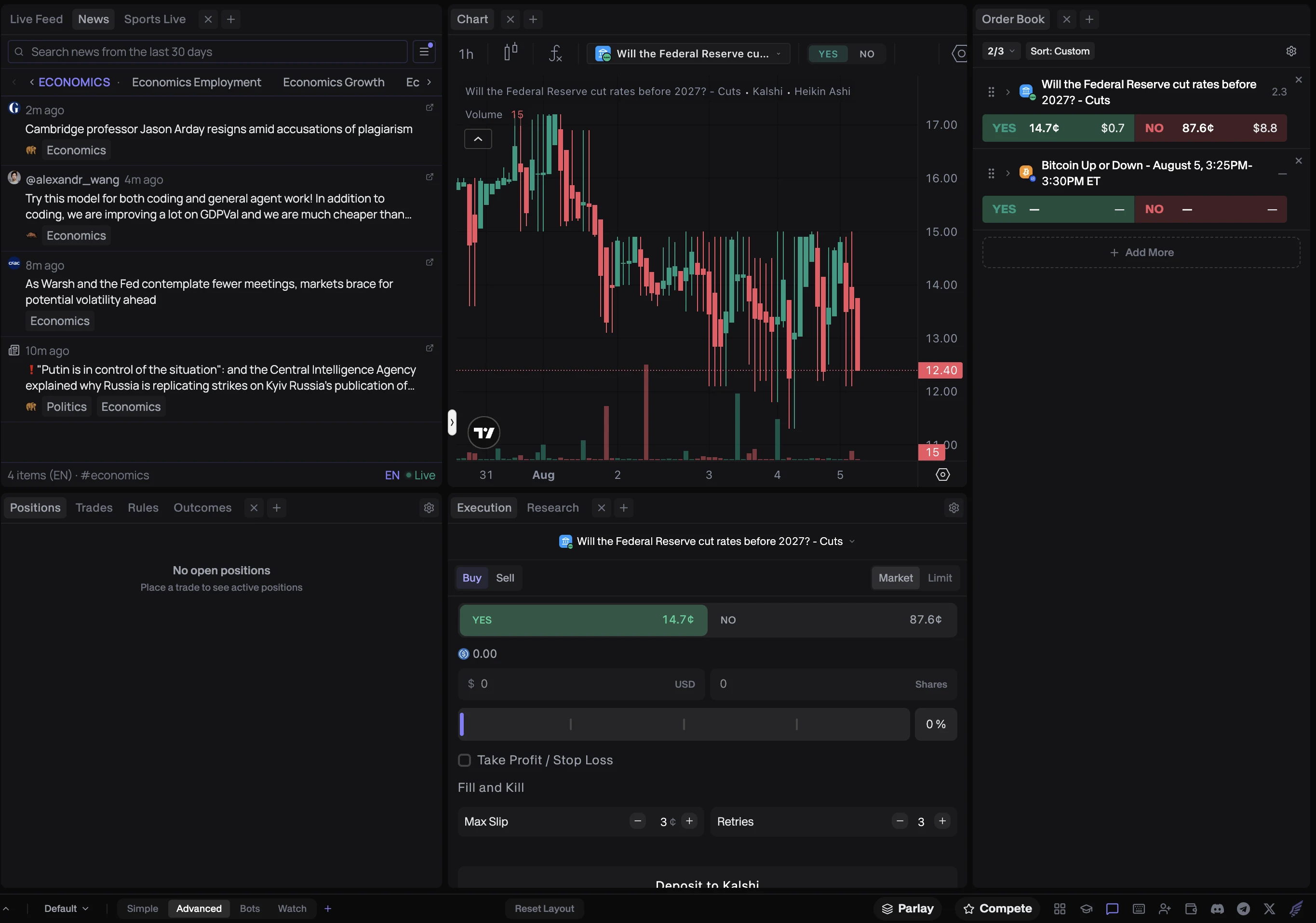
It is also free to trade on. No terminal fee, no maker fee, no taker fee on top of what the venue charges. Full detail on what each venue itself costs is in the best prediction market apps breakdown.
Going direct, the simplest answer and sometimes the right one
If you only ever traded one venue through Fireplace, open an account there and be done. Kalshi in your own name is a regulated relationship with a CFTC-designated exchange that issues tax forms. Polymarket direct puts the wallet back in your hands.
You lose aggregation, which is the whole reason terminals exist: you stop seeing the best bid and offer across venues, you price each market against one book instead of all of them, and any arbitrage between Kalshi and Polymarket becomes invisible to you. If you traded one venue anyway, that costs you nothing. If you traded both, it costs you the spread on every trade, forever.
Analytics tools do research, not execution
A cluster of dashboards will tell you what wallets are doing on Polymarket. They are useful and several are free. None of them lets you trade, so treat them as a replacement for Fireplace's tracking features and not for its terminal. Our own live tools sit at Kairos tools and cost nothing to use.
How to move your book in an afternoon
- Screenshot the book first. List every open position: market, side, size, average price. You want a record of what you held before anything moves, independent of a company that is closing.
- Export your history. Do it before the migration, not after. This is the step nobody remembers until April.
- Open the accounts in your own name. A Polymarket wallet for the migration to land in, and a Kalshi account if you traded that side.
- Cancel orders, then migrate. Fireplace moves positions and cash to your Polymarket address in one on-chain transfer. Copy address, not deposit address. Check it twice, because it cannot be undone.
- Point a terminal at the accounts. Connect them to Kairos and you are back to one order book across venues, with the same positions you started the week with.
The whole move takes an afternoon, and none of it requires selling a position. Doing it in the last week, alongside everyone else who left it late and with a support desk that is winding down, takes longer and goes wrong more often.
What this says about prediction market terminals
The lesson is not that terminals are a bad idea. The volume says otherwise: Kalshi traded roughly $135bn in the first seven months of 2026 and Polymarket's global venue roughly $61bn, on infrastructure most traders still reach through a browser tab.
The lesson is that the interface is the easy part. The hard parts are custody, venue integrations that change under you without notice, and a regulatory surface that moves every quarter. Take custody and you have inherited a balance sheet problem on top of a software problem. That is a lot to carry on $1.5m.
So the question to ask any tool you move to is not how good the charts look. It is who holds the money, what happens to your positions if the company stops answering email, and whether the thing is funded to still be here in November.
Fireplace is not an outlier either. We track every tool built on these venues, and at the last check 21 of the 288 were already dead or unreachable. The full list, with what each one covers and whether it survived, is in our best prediction market tools census.
A prediction markets trading terminal should own the execution layer and nothing else. Your money belongs with the exchange. Your keys belong to you.
The dates that matter
| Date | What happens |
|---|---|
| 27 January 2026 | Fireplace launches publicly after a 30,000-trader waitlist. |
| 17 February 2026 | $1.5m pre-seed announced, led by Frachtis with White Star Capital. |
| 10 August 2026 | Shutdown announced on X. The wind-down and migration flow go live the same day. |
| 15 August 2026 | Trading on Fireplace ends. Per the banner on its own wind-down screen. Cancel resting orders before this. |
| 30 September 2026, 23:59 UTC | Hard cutoff. The app goes offline. Migrate, export and ask support anything before it does. |
| 3 November 2026 | US midterms resolve. Positions migrated to your own wallet are unaffected and settle normally. |